
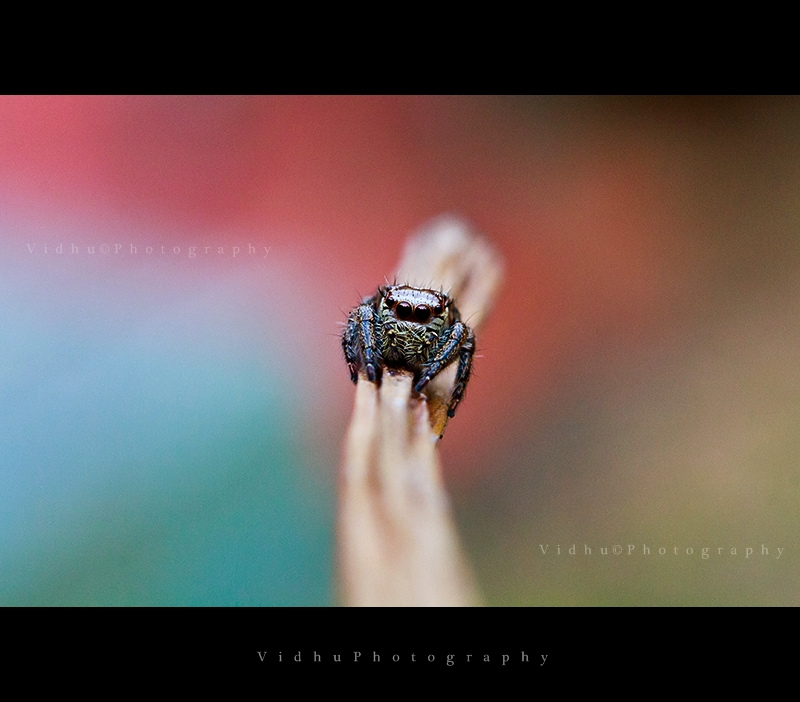
F8, ISO 800, I/160s
In my post on lens reversal technique for macro photography, I mentioned some challenges you face when you reverse a lens . So, in this article, I shall explain how to overcome those challenges to take better photographs using this technique.
Choice of lens, magnification, and image quality
Using this technique, you can reverse any type of lens you want – from wide angle lenses to telephoto lenses. So how does one select the type of lens for reverse mounting?
When the focal length of the reversed lens is small, the magnification is high. For example, when you reverse a 28mm lens, you get a 3X magnification. And when you reverse a 50mm lens, the magnification becomes 1X.
If you are reversing a wide angle lens, say, a 18-55mm kit lens, you can adjust the magnification by changing the focal length. I.e. magnification at 18mm is higher than the magnification at 55mm. The drawback of using a reversed 18-55mm kit lens is:-
- You don’t get sharp images.
- When the focal length is at wide angle ranges (below 28mm), vignetting occurs (dark areas around the corners)
I always prefer reversing a prime lens. There is not much optics present in prime lenses. Thus, they give sharp images. The only drawback is that you cannot change the magnification as you can do in a zoom lens. A reverse mounted 50mm gives you life size magnification (1:1) and a reverse mounted 28mm gives you 3x magnification.
So, the selection of the lens depends on :
- Magnification you want to achieve
- Image quality
How to change the aperture?
Since reverse mounted lenses don’t have any electronic contact with the camera, the F-number will be shown as F00
A lens in reverse mount does not have any electronic contact with the camera. So, one cannot change the aperture of the lens from the camera. Because of this, the camera displays the fnumber as f00 (as shown in the picture) Then, how do you change the aperture? Well, it depends on the lens you are using:
Some lenses have an aperture ring to change the aperture size. For such lenses, you can use the on-lens ring to change the aperture.
For those lenses which do not have an aperture ring, the f-number has to be set in advance before reverse mounting it. Here is how it is done in canon cameras:
- Mount the lens normally
- Set the desired f-number.
- Now press the Depth of field preview button (shown in the picture). This closes down the aperture to the f-number you have set. So, while depressing the DOF preview button, detach the lens from the camera.
- Reverse mount your lens.

Press and hold the depth of field (DOF) preview button while detaching the lens from the camera..
How to control the depth of field?
When the magnification increases, the depth of field will become too shallow. i.e. the area of focus will be small. It results in blurry images. So, the selection of aperture depends on the magnification of the subject. Here’s how it is:
For the same f-number, the depth of field is inversely related to the magnification of the subject. Let me make this clear to you: At f8 a 3:1 magnification would give a more shallow depth of field than the depth of field at 1:1 magnification.
So the bottom line is, to get more area in focus, choose a larger f-number depending on the magnification. I usually go for f8 (or f9, depending on the available light) when I use reversed 50mm – 1:1 magnification. And for a 2:1 magnification, I prefer f11 to control the depth of field.
Focus
Since the lens loses its electronic contact with the camera in reverse mount, you may not be able to auto focus. Also, manual focus will not work because of the lens’ close proximity to the subject. A reverse mount lens has a fixed plane of focus. So the only solution is to physically move yourself or the subject into focus. So using a tripod is practically impossible.
Lighting
You cannot trust your camera’s inbuilt light meter once you reverse the lens. So you have to do some trial and error to find a good exposure. Another important issue you experience is the loss of light. As I have said before, you have to use a narrow aperture to control the depth of field. So obviously there will be loss of light. The solution is to increase the ISO or decrease the shutter speed to let in more light. But this may result in noisy (due to high ISO) and blurry images. Another solution is to use a flash with a diffuser.

Putting it all together
An optimal setting is important for getting good results. The selection of aperture is crucial as it controls the depth of field and light coming into the camera. I.e. if you choose a very small aperture to control depth of field (large f-number), it cuts down the light. And even if you use a flash along with it, you would get a low key image. So select the f-number wisely – make sure you get natural light and a proper depth of field.
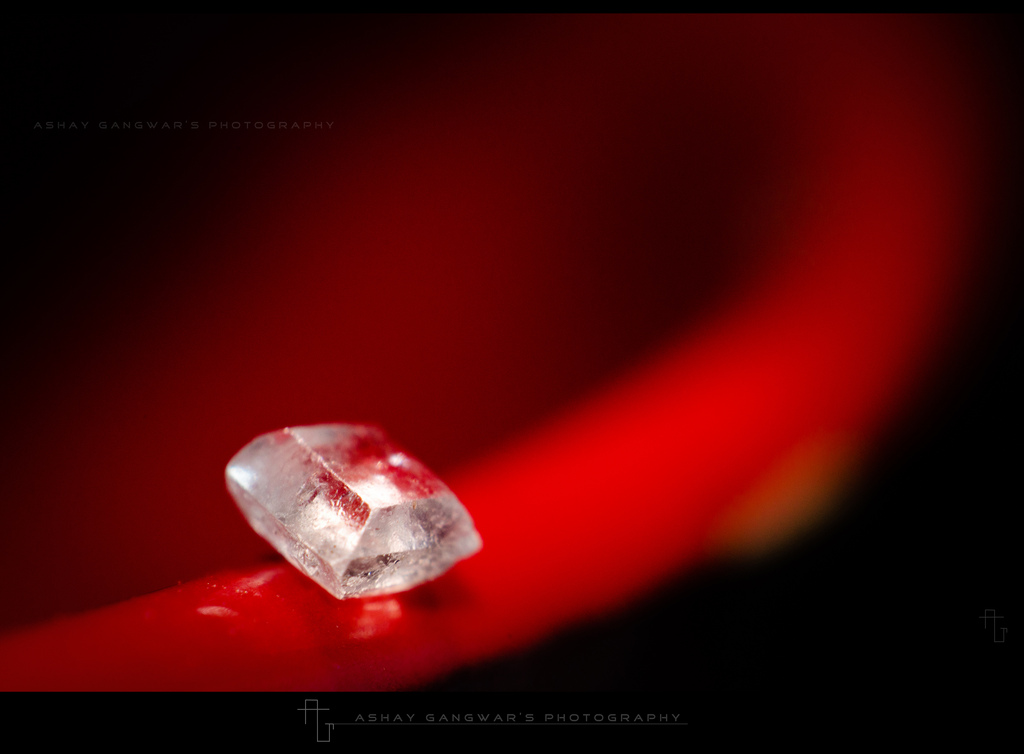
A sugar crystal
Photo Credits: Ashay Gangwar
A reality check
To be frank, taking macro photographs using a reverse mounted lens is not the best solution for macro photography. It has a lot of limitations – the autofocus will not work which makes it difficult to photograph moving subjects; you have to use narrow apertures which cuts down natural light; and if you are taking macro photographs of insects, getting close to them might scare them away. You need a lot of practice to get the hang of using this technique. But I can assure you that the end results are rewarding. Anyway, it’s a very cheap macro photography technique. So why not give it shot.
So, ready to try this technique out? Why don’t you share your shots in our Flickr group: Shutterstoppers Flickr group


